In this piece, we take look at the 2025 GDP report published by the National Bureau of Statistics and share our thoughts on how the report should be interpreted.
The National Bureau of Statistics has just released its national accounts for 2025, and the headline the bureau wants from them is the obvious one: the economy grew. It did, by 3.1 percent in real terms. Its cover carries the words SOMALIA ECONOMIC GROWTH set in three dimensions on a lawn. A complete horumar.
I want to do two things here. First, to walk through what the national accounts actually say, which is more interesting than the headline and a good deal less flattering. Then, to argue that Somalia's figures describe a specific kind of economy, common enough in the poorer latitudes but rarely named with any precision, and to give it a name and a small theory.
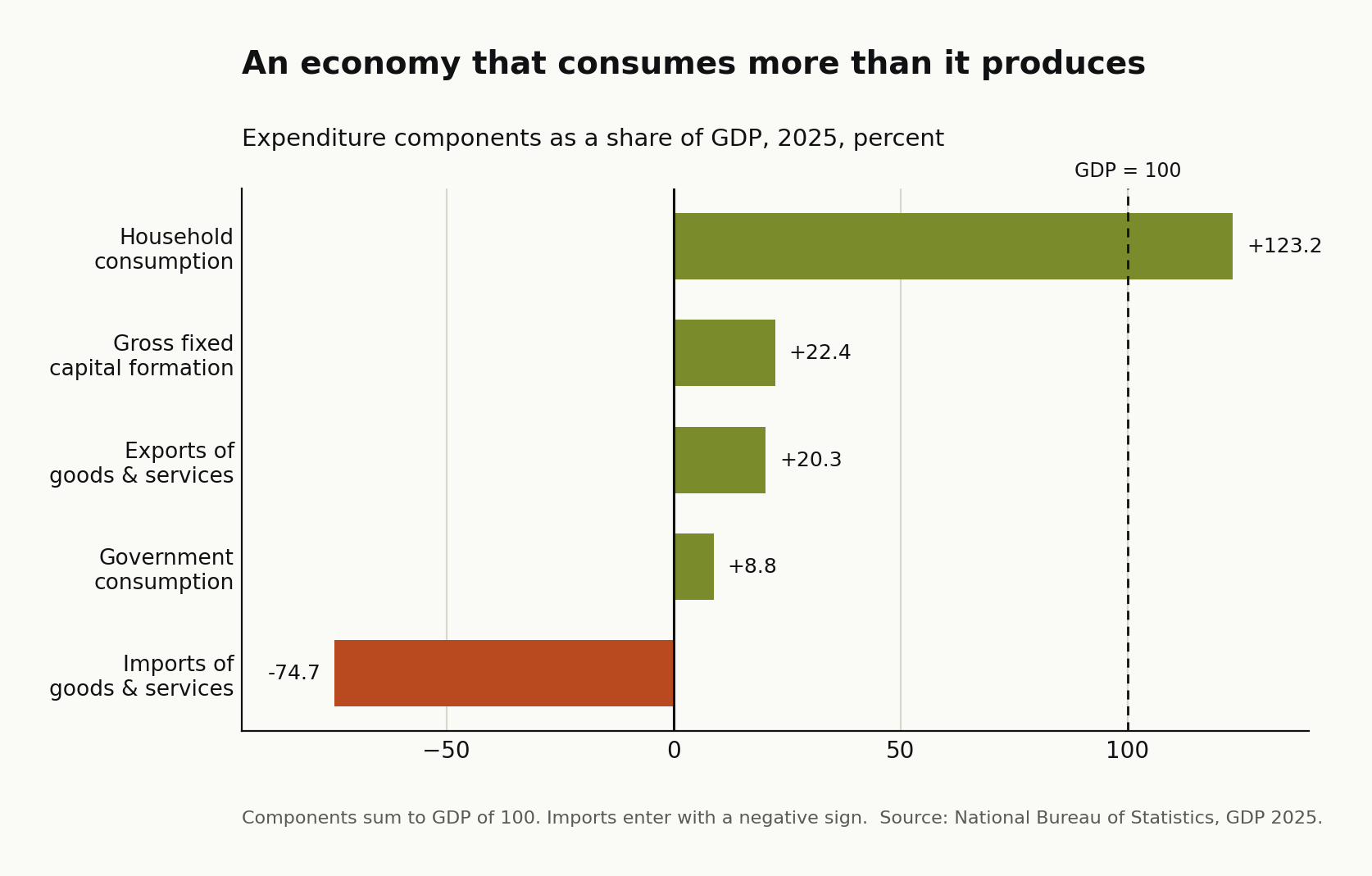
Begin with the largest number in the accounts, which is larger than the economy itself. Household consumption in 2025 was equivalent to 123 percent of GDP. This is not a misprint and it is not new; the ratio has sat above 100 percent in every year the bureau publishes. A country cannot consume a quarter more than it produces out of its own production. The surplus is therefore imported, and imports duly ran at just under 75 percent of GDP against exports of 20 percent. That means Somalia buys from the world roughly four times what it sells to it. What it does sell is shrinking, too: livestock, the export Somalia is almost stereotypically known for, fell 10.3 percent in real terms for the second consecutive year as the drought thinned the herds.
The gap is filled from abroad, and the accounts are candid enough to show by how much. Gross national disposable income, which is GDP plus the net income and transfers Somalia receives from the rest of the world, came to $17,299 million against a GDP of $13,234 million. Put plainly, around a third of the money spent in Somalia in 2025 was earned somewhere else. Per head, output was $793 and disposable income $1,037. The difference, $244 a person, is a serviceable measure of how much of Somali life is underwritten by the global diaspora.
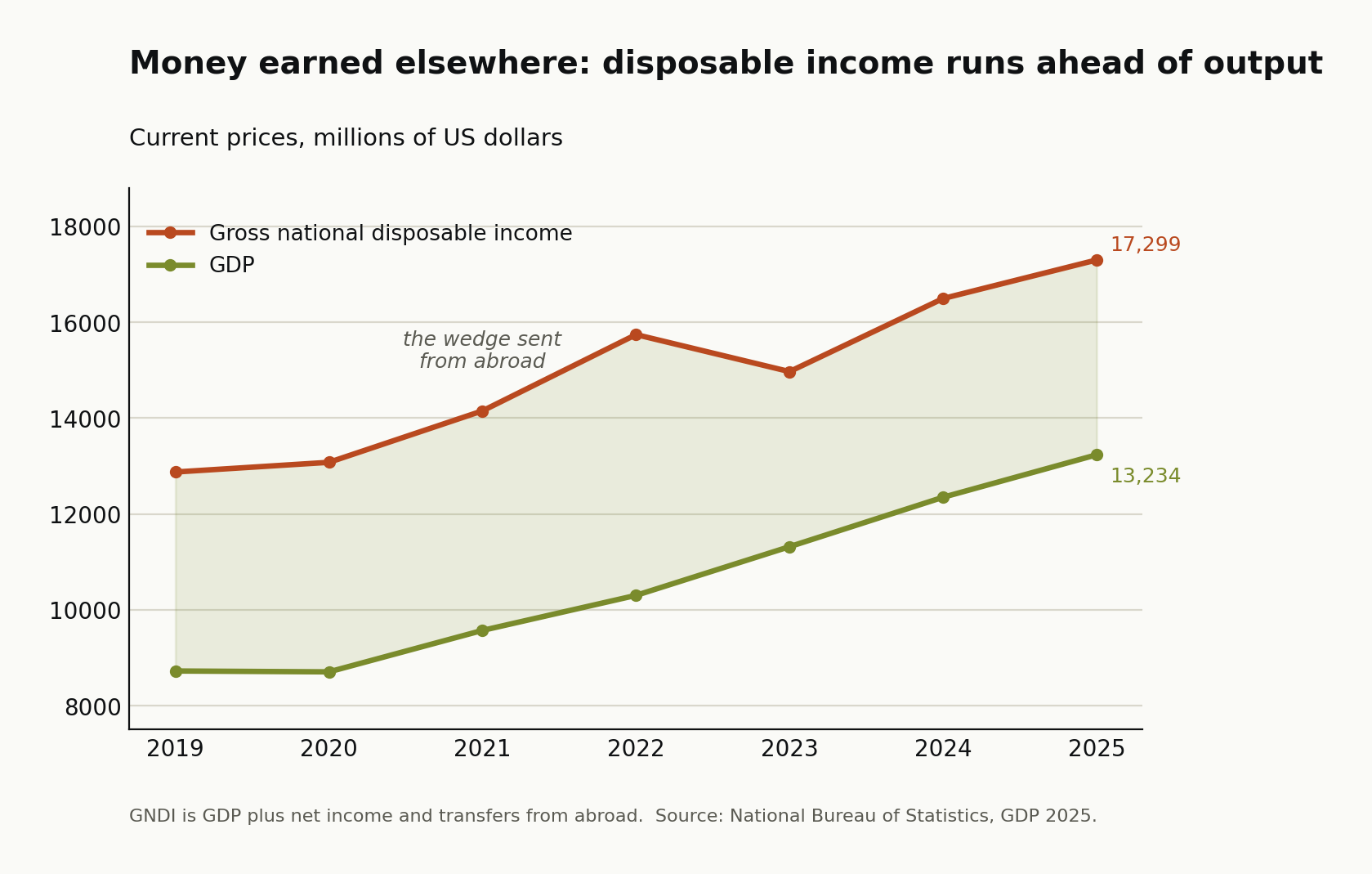
The report also clearly shows two starkly different flows are responsible for the underwriting: remittances from the diaspora, and aid from foreign donors. Remittances have kept climbing, as they have for years, steady and counter-cyclical. Foreign aid fell.
The cut was of a piece with the Trump administrations wider posture toward Somalia. Within months it had reinstated a travel ban placing the country among the handful whose nationals are barred from the United States outright, a measure first imposed in 2017 and widely condemned as discriminatory; its own fact sheets branded Somalia a "terrorist safe haven"; and the president had publicly racially disparaged the Somali-American community in Minnesota. An administration this hostile to Americans of Somali extraction at home was never likely to keep financing a Somali state abroad.
Most of the effect therefore belongs to 2026. In January 2026 Washington suspended what remained of its assistance to the federal government directly, and the wider donor retreat shows no sign of reversing. The single clause the bureau gives to falling aid in this release is likely to become the central fact of the next one.
So what do these numbers actually mean?
The official temptation is to read 3.1 percent growth as a productive economy expanding. This is the wrong picture. Somalia's GDP, measured as it is from the expenditure side, is overwhelmingly a record of spending, and the spending is overwhelmingly financed by money the country did not earn through production of goods and services. When the report announces that the economy grew, it is saying, in large part, that more money arrived from abroad and was spent inside Somalia. That means growth is not first of all a measure of what Somalis made. It is a measure of what foreign aid and the diaspora sent.
There is a body of theory for economies of this shape, and it is worth borrowing from. The literature on the rentier state, which Hossein Mahdavy named while writing on Iran and which Hazem Beblawi and Giacomo Luciani later built out, describes states that live not by taxing their own producers but on rent that accrues from outside, classically oil. The rentier state, the argument runs, is a distributive rather than a productive thing. It need not tax its citizens, so it need not bargain with them; no taxation buys no representation. Its productive economy withers because it does not have to exist, and its politics curdles because revenue falls from the sky rather than rising from the work of the governed. I do not raise this in order to file Somalia under an existing heading and walk away. The Somali case is a variant sharp enough to deserve its own name, because it strips away the single comfort the oil rentier enjoys.
The oil state, whatever else ails it, owns its rent. The well sits on its territory; the state controls the tap, sets the output, banks the revenue directly. Its curse is volatility and indolence, not the goodwill of others. Somalia owns nothing of the kind. Its rent does not lie under its soil. It arrives, monthly, as transfers earned by Somalis who left and grants released by governments answerable to their own electorates. The state does not own the source, does not govern the flow, and in the case of remittances does not so much as touch the money, which travels from a relative abroad to a household in Mogadishu or Bosaso without ever passing through the treasury.
Call this the vicarious rentier: a Somali state that enjoys the rentier's distributions while holding none of the rentier's levers, living on rents it neither owns nor commands, in the reflected income of its emigrants and the discretionary mercy of foreign states.
The mechanism the federal government can and should control, and is increasingly doing so, is taxation, which is the purview of the state. The government raises a little over 3 percent of GDP in domestic revenue, among the lowest ratios on earth, and has set itself the goal of covering its own operating costs from its own revenue collection by 2027. The recent aid cuts make that target harder to reach.
The way out, which the government has begun and should now treat as the whole game rather than one reform among many, is to shift the weight of taxation off the port and airport alone and onto the domestic economy: the income tax it has only lately started to enforce, and the consumption taxes that fall on spending wherever the money behind it came from. A tax that does not care whether a dollar arrived from the diaspora or was earned in Mogadishu is the only kind that survives the withdrawal of the diaspora. Focusing on revenue collection, widening the tax base and fostering a social contract whereby the state is accountable to its taxed citizens will wean it away from diaspora transfers that are subject to the banking regulations of foreign states, and which can be restricted at will.
The central bank, by contrast, can do almost nothing here, because the reflex in any downturn is to look to the monetary authority. Somalia is dollarised. There is no domestic interest rate to cut and no currency to print into a slump; the planned reintroduction of the shilling under a currency board is a reform of payments and financial inclusion, not an instrument of stabilisation. The one genuinely macroeconomic task left to the Central Bank of Somalia is also the most important right now: keep the remittance tap open. That means the unglamorous labour of satisfying foreign correspondent banks that Somali banks and money-transfer operators are not conduits for laundered money, because on the day a major correspondent decides the compliance risk is not worth the business, the diaspora's billions have nowhere to land.
The instant payment system the bank launched in 2025, which lets the country's banks and mobile-money providers clear across a single interoperable rail for the first time, is what makes remittance-financed spending observable. Somalis already run an estimated 155 million mobile-money transactions a month, worth about $2.7 billion. The instrument that fits is not a levy on the transfer, which pushes users back to untraceable cash, but a sales or value-added tax collected at the point of sale from registered merchants. It taxes the dollar when it is spent, whether earned in Mogadishu or wired from the diaspora, and broadens the base without touching the remittance corridor. Paired with the income tax the government has begun, unevenly, to enforce, it would let the customs base contract in line with falling imports without widening the deficit.
Finally, the headline rate does not measure production. A 3.1 percent real rise in expenditure, in an economy where consumption runs at 123 percent of GDP and imports at 75, records how much external money was spent, not how much was produced at home. It leaves two gaps, and they are not the same. The fiscal gap is the government's: the vanishing aid, worth 3 to 4.5 percent of GDP, financed budget and relief spending that only domestic revenue, about 3 percent of GDP against a 2027 self-financing target, can now begin to cover. The external gap is the economy's: consumption above output, financed by remittances the treasury never touches, which narrows only if the diaspora keeps sending or Somalia produces and exports more. Taxation can close the first, not the second; the value-added tax above matters because it draws state revenue from remittance-financed spending without pretending to replace the remittances. The alternative to both is contraction, which needs no policy and happens by default. Choosing revenue over contraction is what ending the vicarious rentier means in practice, and it is the central economic decision facing Somalia over the next three years.