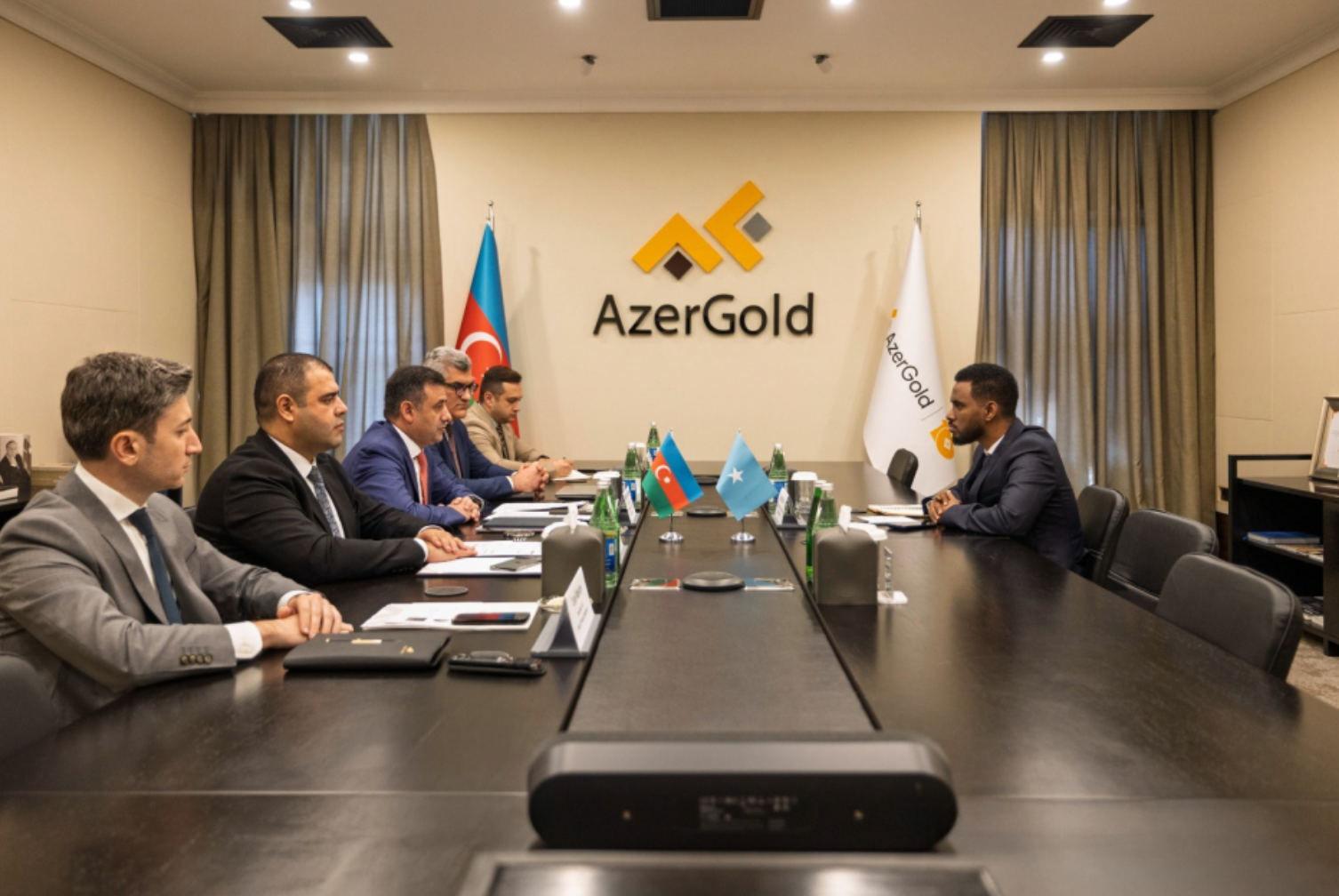
Azerbaijan’s state-owned mining company, AzerGold, opened discussions with the Somali Development and Reconstruction Bank (SDRB) on June 18 over potential cooperation in mineral exploration, financing and technical development, in what could signal growing international interest in Somalia’s long-overlooked mining sector.
The meeting, first reported by Azerbaijan’s state news agency AZERTAC, did not produce a formal agreement, yet it comes at a time when Somalia is quietly laying the institutional and technical groundwork for a broader push into mineral extraction.
For Azerbaijan, the talks fit into a wider strategy of expanding its mining footprint abroad. AzerGold has in recent years increased engagement across Africa as Baku looks to diversify its mining partnerships beyond domestic operations. Somalia, with its largely untapped mineral reserves and limited foreign competition, offers a high-risk but potentially high-reward frontier. Somalia is believed to hold significant reserves of gold, uranium, iron ore, tin, gypsum and rare earth minerals. Yet much of that wealth remains commercially dormant, constrained by insecurity, weak infrastructure and limited geological data.
That data gap is now becoming a focus of state policy. According to Somali officials, the federal government is undertaking a national program aimed at studying, mapping and restoring historical geological records related to Somalia’s underground resources, including gold, uranium, lithium and titanium. The initiative appears to involve the recovery of pre-war geological archives, digitisation of legacy mineral maps and fresh field-based surveys.
The significance of that work is substantial. Before modern mining concessions can be licensed, governments need reliable geological mapping, reserve estimates and concession boundaries , all areas Somalia has lacked for decades following the collapse of central institutions in 1991.
Recent efforts suggest that is beginning to change. UNESCO has republished Somalia’s landmark 1994 geological map, while the Ministry of Petroleum and Mineral Resources has begun consolidating updated mineral datasets and geological mapping through its own public portal. Together, the efforts point to a broader attempt to rebuild the technical backbone of the mining sector.
However, the legal framework remains incomplete. Unlike the petroleum sector, where Somalia passed a modern hydrocarbons law in 2020, mining is still largely governed by a 1984 Mining Code, legislation written before the collapse of the state. While a National Mineral Resources Policy was introduced in 2019 and a modern Mining Bill drafted in 2023, parliament has yet to pass the law.
The federal government has already moved to establish the fiscal side of the sector. In 2023, Somalia passed a new Extractive Industries Fiscal Regime Law, standardising royalties and taxation across both petroleum and minerals, a key step in building investor confidence and future public revenue streams.
For the SDRB, the talks with AzerGold fit within its broader mandate to channel investment into underdeveloped sectors of the economy. While agriculture, fisheries and infrastructure have dominated much of its recent focus, mining may increasingly emerge as a strategic priority.